CF Montréal sign Chilean legend Alexis Sánchez to DP contract - can he actually spark struggling side to short-term success?


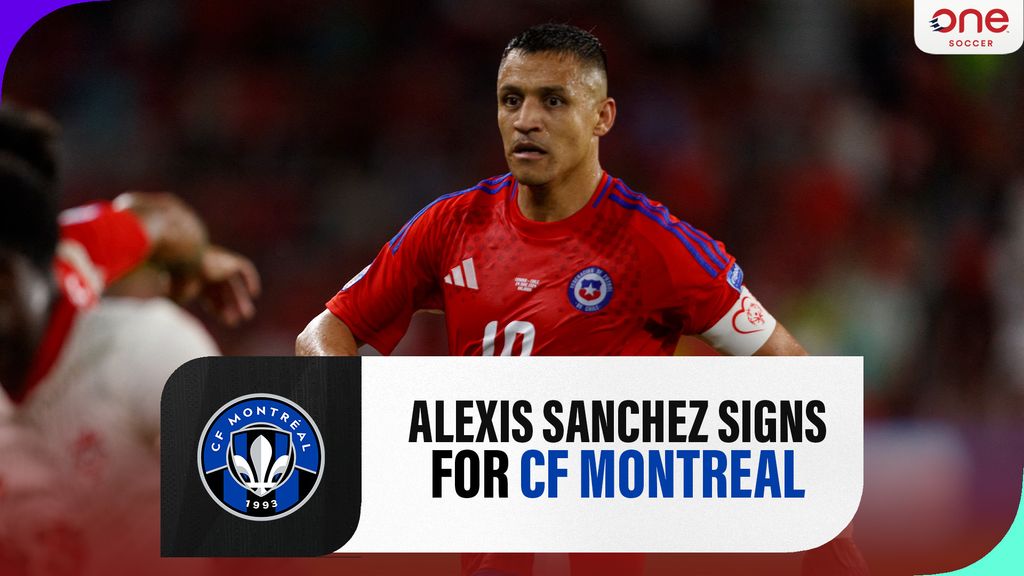
CF Montréal have made a big summer splash, as they announced the signing of Chilean legend Alexis Sánchez as a Designated Player on Tuesday.
Signed on a contract through MLS’s 2027 Sprint Season, with a club option for the 2027-2028 campaign, Sánchez will hope to deliver an immediate impact for his new side, who still have a lot to play for in 2026 despite a slow start to the season.
¡Bienvenido, Alexis! 🇨🇱
— CF Montréal (@cfmontreal) August 11, 2026
Le CF Montréal fait l'acquisition d’Alexis Sánchez à titre de joueur désigné >>> https://t.co/T9omkYtJPQ
CF Montréal signs Alexis Sánchez as a Designated Player >>> https://t.co/NL1Jus33ID
Billets / Tickets 🎟️ https://t.co/A0OGzGyEQz#CFMTL pic.twitter.com/sn3TOEzI7j
They may sit in 14th place in the Eastern Conference with just 16 points from 18 games, but they’re only seven points behind a playoff spot, which is a more than realistic gap to make up in their remaining 16 MLS games. Then, of course, it can’t be forgotten that they’ve also reached the semi-finals of the Canadian Championship, where they have a great chance to win their first trophy since winning the 2021 edition of that tournament, even if they’ve got a tough matchup against the reigning four-time champions, the Vancouver Whitecaps, in the next round.
Certainly, with the signing of Sánchez, it’s hoped that the veteran attacker can push this side, who is winless in their last seven games, to hit another level, whether that’s to reach the playoffs or to win a Canadian Championship (or both).
Now, though, as is the case with the arrival of a player with Sánchez’s pedigree, the immediate question that Montréal will be asking themselves is what version of the 37-year-old attacker they’re getting.
They won’t pretend that they’re getting the player that scored double-digit goals in every season between 2010-2011 and 2016-2017, including hauls of 21 across all competitions with FC Barcelona in 2013-2014, 25 goals for Arsenal in 2014-2015 and 30 goals for Arsenal in 2016-2017.
Happy birthday, Alexis Sánchez! 🥳#UCL | #HBD | @Alexis_Sanchez pic.twitter.com/0uw7IXUWJh
— UEFA Champions League (@ChampionsLeague) December 19, 2020
In a best-case scenario, they’ll hope that Sánchez can reproduce anything close to the 18-goal haul he had for Olympique de Marseille in 2022-2023, which is the lone season since 2016-2017 in which he’s even scored double-digit goals. Heck, they wouldn’t mind if he found a way to replicate the two-season period for Inter Milan in 2019-2020 and 2020-2021 in which he generated 17 assists, if that means he’s helped spark the sixth-worst attack in MLS to new heights.
Ultimately, though, they’ll understand that they’re getting a version of Sánchez that is nowhere near the peak of his powers, having scored just four goals and generated two assists across his last two seasons combined.
At the same time, that doesn’t mean that he can’t be an effective signing, as long as it’s understood what he can bring to the table for this team.
Firstly, there’s the reality that Sánchez is being brought in to provide leadership for a young Montréal team, one that has used the fourth-youngest team in MLS on average this season (with an average age of 24.5) per Transfermarkt. By bringing in a player who has won some huge trophies in his career, including La Liga and Serie A titles, as well as two Copa América titles for Chile, that’ll be a big boost for a team filled with players in their early 20s.
Secondly, there’s the reality that while Sánchez isn’t at his top level, he still has some juice left in the tank. During the 2025-2026 season, which he spent with La Liga side Sevilla, he had four goals and two assists in 1300 minutes of action in league play, which isn’t bad considering the level and his age.
Yet, to that point, that’s arguably the biggest risk of this move from Montréal’s standpoint - the worry isn’t so much that Sánchez’s output has declined in recent years, but instead, his availability.
In 2025-2026, he played just over 1400 minutes, in 2024-2025, he barely played 500 minutes, and in 2023-2024, he barely played over 1000 minutes. In fact, other than the 2022-2023 season he had with Marseille, where he played over 3000 minutes, he has only cracked 1500 minutes one other time since the 2018-2019 season, and that was when he had 1556 minutes for Inter Milan in 2020-2021. (For context, 1500 minutes is around 16 full games worth of minutes).
That’s a big worry, as Sánchez is moving to a league that isn’t exactly kind on the body, with MLS’s schedule, travel and overall intensity usually taking a toll on older players - and that’s without going into factors such as the turf that some teams play on (it does help that Montréal plays on a grass surface… for now).
TRANSFER CONFIRMED ✅
— OneSoccer (@onesoccer) August 11, 2026
CF MONTRÉAL sign ALEXIS SÁNCHEZ 🇨🇱 as a Designated Player ✍️
"I am very happy to join #CFMTL and take on this new challenge. I’m grateful to the club for the confidence they’ve shown in me." pic.twitter.com/FApD2DxxgA
When Sánchez has been on the field, he’s still been productive - staying on the field has been his biggest challenge, which shows why the biggest reason for his raw numbers dropping in recent years has actually been his own availability.
For example, look at the advanced numbers from this last season with Sevilla. Despite playing on a team that narrowly avoided relegation from La Liga by two points (they somehow finished 13th despite that, as just five points separated 10th place Real Sociedad and 19th place Girona in a strange La Liga season), Sánchez’s underlying numbers were actually quite good.
Based on this percentile chart, Sánchez was still an above-average chance creator at his position in La Liga, as he had strong metrics in terms of his key passes, expected assists, assists, cross success and progressive passes. And, he still had strong dribbling numbers, too. 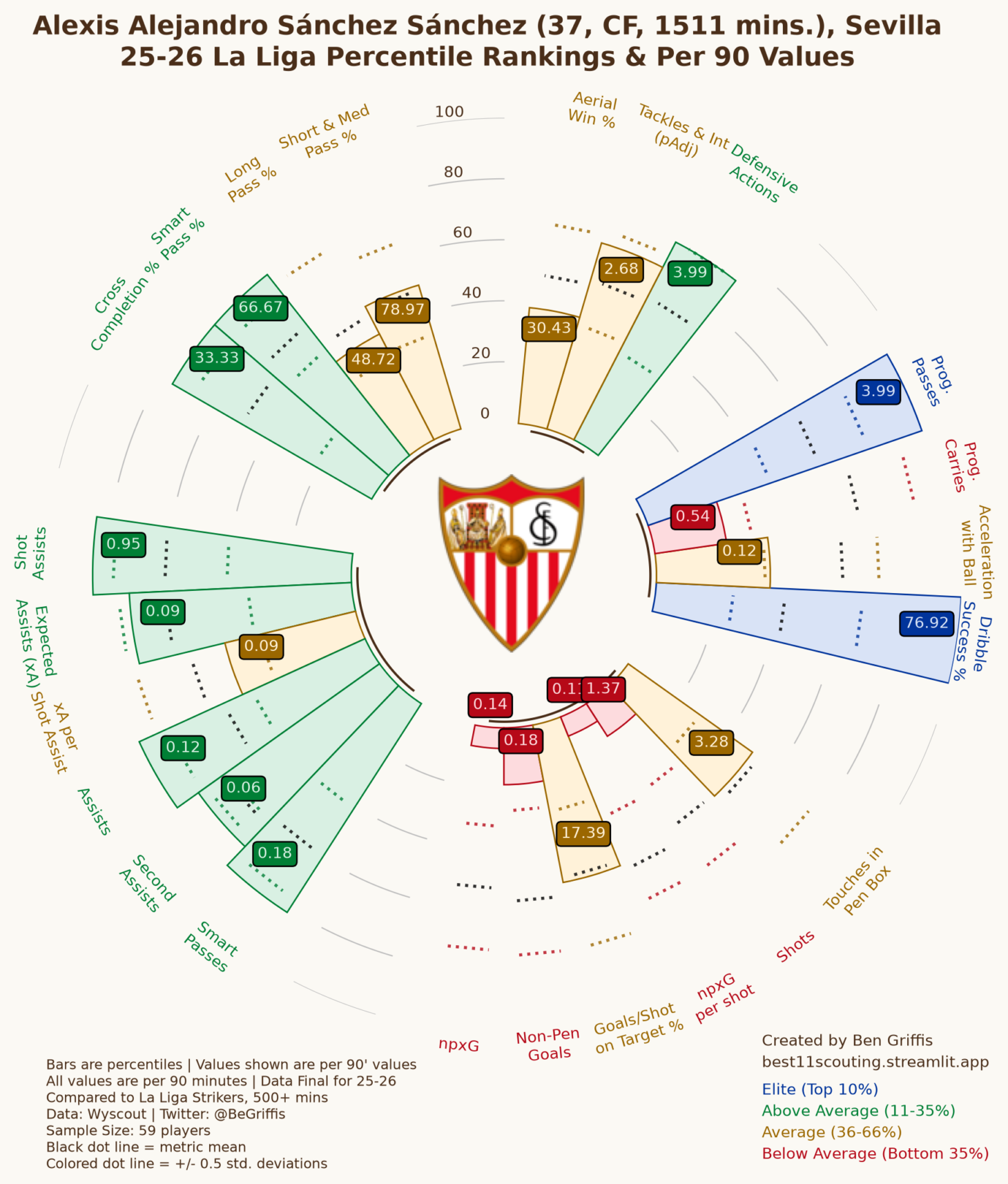
Sánchez's percentile chart from the 2025-2026 La Liga season (WyScout)
His shooting numbers weren’t great, yes, even if he got to the box at a decent rate, but that shows that perhaps Montréal could benefit from him playing a role where he tries to create chances for Prince Owusu, who already has 11 goals across all competitions for Montréal this season after scoring 17 goals in 2025.
If Sánchez could be deployed in a way where he can offer more support for Owusu, who also has six assists (no one has more than three assists), that could be key, as Montréal haven’t done a great job of supporting Owusu despite his impressive numbers (which make them stand out even more). With his creativity, which should easily translate from La Liga to MLS, Sánchez could help make life easier for Owusu, and from there, any goals he’d provide would be seen more as gravy for a team whose next best goalscorer is Wikelman Carmona with five goals and Daniel Rios with four goals.
That’ll be easier said than done, of course, as Montréal will have to find a way to integrate Sánchez into their team while managing his body, a challenge that won’t be easy given his injury history and the fact that he’s coming off an offseason of rest.
At the same time, given the state of their attack, Sánchez should prove to be an upgrade for a team that needs any sort of offensive talent to surround Owusu with, which shows why Montréal are willing to take this risk, one that isn’t cheap given Sánchez’s status as a DP.
Plus, it can’t be forgotten that while Montréal are hoping that Sánchez can provide any sort of value on the pitch, the reality is that this deal is a big one for them from an off-field perspective, and while that might not typically matter in modern football, that isn’t the worst thing for this Montréal team right now.
A side that has had one of the lowest payrolls in MLS in recent years, as they’ve usually shopped in the bargain bin, it stands out to see them pursue a big-name player on a bigger contract, even if it’s an older player who doesn’t have the same reputation that he once did.
This is a Montréal side who used to make signings like this quite regularly - this is a team that has been home to the likes of Alessandro Nesta, Marco Di Vaio, Didier Drogba, Bacary Sagna, Bojan Krkić and Victor Wanyama, after all, showing that it isn’t that wild to see a player of Sánchez’s ilk sign for Montréal for those who have watched this team for a long time.
It’s only a surprise in the context of recent Montréal teams, who have been reluctant to sign players of that calibre, but perhaps this is a sign that things are changing for them on that front.
Certainly, it’s a move that caught the attention of many who follow the team, perking discussion around the team, which is what they’ll have wanted when making such a move. Now, if this signing can get people talking about the team and filling the stadium with more fans, then it’ll have been seen as a win, no matter what happens on the field.
Of course, for this signing to truly be a win, it’ll have to spark a new era for this Montréal side, one where they bolster their squad and start filling their DP spots more regularly, finding a way to field a team that can push for trophies.
For now, though, it’s just a move that sparks curiosity, both in terms of seeing how Sánchez fits on the field and the buzz he brings to the club - even if it remains fascinating to see what this move does for a club that is trying to rid itself of the obscurity it has found itself in.
Because as easily as this move could be seen as a next step for Montréal, it could also be seen as a desperate move, especially in the context of modern MLS, where teams have moved away from bringing in big names just for buzz - now, the focus of top teams is bringing players who they feel can help them win, big name or not.
Such is the line when it comes to making signings in this era of the league, after all. Just ask someone like Lorenzo Insigne, who had a disappointing spell with Montréal’s biggest rivals, Toronto FC.