KEY TAKEAWAYS: CanMNT left to sputter in frustrating 1-0 defeat to the USMNT


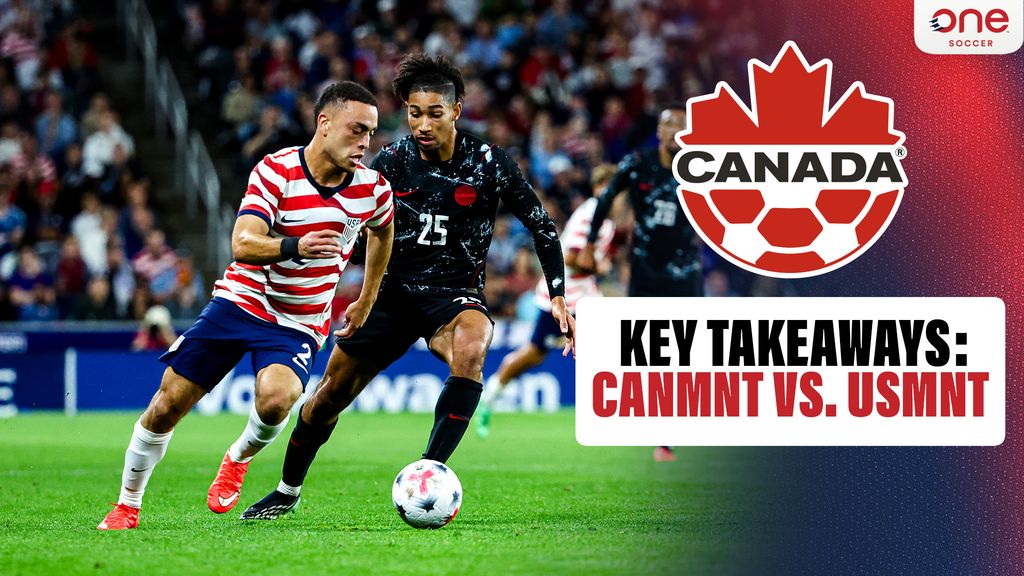
It wasn’t the end to the September/October window that the CanMNT were hoping for, as they fell 1-0 to the USMNT in Minnesota on Tuesday.
After opening the window with a pair of wins over Chile and Peru, Canada were hoping to keep the good times rolling against their neighbours and rivals, but instead, they suffered a rather forgettable road defeat.
Despite entering the match with more of a desire to prove themselves than their counterparts, Canada were unable to find the level required to beat a sound and organized US team, one who never really seemed threatened on the day.
To be fair to the US, this win capped a perfect window for them, so it’s not as if Canada’s loss to them was an anomaly. Despite calling in an extremely young squad, the US cruised through the four games they played this window (coming against Canada, Mexico, Chile and Peru), winning all four by a combined score of 12-3.
What this shows is that heading into the big competitive games that await in Concacaf over the next 12 months, the US might be the team to beat right now, even if Mexico are the defending Concacaf Nations League and Gold Cup winners, and if Canada has had the upper edge in recent meetings against the US (winning three of the last five before this most recent defeat).
To return to Canada, however, it also shows the work they still have to do in order to accomplish one of their big objectives in this World Cup cycle, which is to win a trophy. They’ve got the players to achieve a goal like that, and have evolved into a legitimate top 30 national team under head coach Jesse Marsch (as seen by a Round of 16 finish at this summer’s World Cup), but they’re still far from their final form as a team.
They remain extremely hard to play against and do a good job of making every game competitive, but a lack of cutting edge in both boxes, especially against better teams, continues to hold Canada back from taking that next step as a side.
Granted, that’s not a big knock on them. Not long ago, they dreamed of being able to compete against top teams, and now that’s something that they have no problem doing. Now, they’ll hope they can take the next leap and become an elite side, one that can go into any game with the feeling that they can not just compete, but emerge victorious, and to do that they’ll need to be more ruthless in both boxes.
They’re close to finding that next level, to be fair, but as this US game shows, close isn’t always enough when it comes to the upper-end of the international game.
With that in mind, here are three KEY takeaways from this US defeat.
What happened to the attack?
Of course, when looking back at the scoreline, the big thing that stood out is that Canada failed to score, and naturally so.
While Canada has struggled to score goals at the rate many would expect them to, this was only the third time they were kept completely off the scoresheet in 2026, with those other two matches being against Morocco in the Round of 16 at the World Cup and against Tunisia in a friendly in March.
More interestingly, though, Canada has typically struggled to score due to a lack of finishing, compared to a lack of chances created. This window alone, they scored just one against Chile despite creating 2.58 xG, while against Peru, they scored two goals on 1.94 xG, which feels like an underperformance given some of the chances they left on the table.
Because of that, it stands out in a big way to see Canada generate just 0.27 xG against the US in this game, as they typically haven’t struggled to generate chances like that in any of their games this year, for all of the ink that’s been spilled about their lack of goals.
Yet, that was the story of their performance against the US, as they didn’t just struggle to create quality opportunities, but struggled to generate any sort of opportunities, period, taking just seven shots and creating just one big chance.
Further to that point, they took just 16 touches in the US’s box, with only one of those touches coming at the feet of Jonathan David, who was marked out of the game, as they just didn’t find themselves in the sort of dangerous attacking positions needed to create good chances.
Does the #CanMNT have a striker problem? 😬 The numbers don't lie... most strikers aren't scoring when they take the pitch for Canada, no matter their form for club So how can Jesse Marsch fix that? It remains his big mission heading into Nations League matches🤔 https://t.co/i4vfOeFLSD
— OneSoccer (@onesoccer) October 8, 2026
Credit has to be given to the Americans, no doubt, as they did a good job of sitting back and protecting their box, and identifying Canada’s best routes to goal, such as the ball going to David’s feet or through their wingers making direct runs (Jacob Shaffelburg and Liam Millar combined for zero out of nine crosses). Clearly, they identified some weaknesses in Canada’s attacking game plan and neutralized them in a way that many teams haven’t been able to do.
For Canada, that’ll give them plenty to think about going forward.
In particular, it may push them to reconsider their offensive game plan, as they might be forced to experiment with how they try to attack teams in the future.
Again, these struggles aren’t new - many have long been asking how this Canadian team can score more goals - so it’s not as if this game is a one-off.
What was new to see, however, was the way they struggled to even generate chances, with this US team potentially using a defensive blueprint that other teams might now be tempted to borrow. 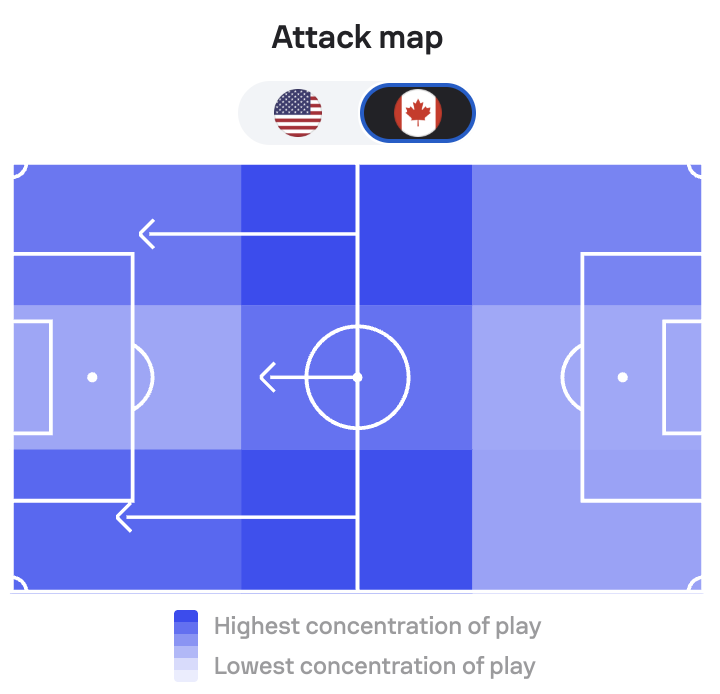
Here's Canada's attack map from this game, showing their issues in terms of probing the US's final third (SofaScore)
To be fair to Canada, they’ll point at some key absences from this game and wonder what they could’ve done to help this team be more dangerous. For example, losing Tajon Buchanan and Cyle Larin before this game hurt, even if either of them haven’t been able to play their best in a Canadian shirt as of late. And that’s without even looking at all of the injured players Canada was dealing with before this window, including Alphonso Davies, Ismaël Koné, Ali Ahmed and Marcelo Flores, all players who could’ve helped spark this attack.
But even if those players were available, would Canada have been able to score? They certainly would’ve been able to generate more chances, but as the story shows, it’s hard to say that would’ve actually led to more goals.
And that doesn’t even address one of the bigger issues with the attack, one that is likely underlying why some have been worried about how this Canadian team's issues in front of goals, even if some of the advanced stats have suggested that they haven’t even been that bad.
That issue? That a lot of Canada’s most dangerous attackers, such as Jonathan David, Cyle Larin, and others, haven’t looked their best in a Canadian shirt lately, while others like Promise David haven’t gotten much of a chance to showcase themselves, period.
The reality with Canada’s attack right now is that they’re not just struggling to convert their chances, but they don’t look to be playing up to their potential, even when they’re creating chances. Which leaves head coach Jesse Marsch with questions about how that can be changed, whether that’s tweaking his system to better accommodate players, or pushing these players to better integrate his system.
Given that he’s spent most of his tenure employing a similar system, the former might be the way to go to shake things up when it comes to jolting this attack, especially when seeing how the US was able to neutralize what this Canadian side typically does best in this game. 
Impact of possession play on defence:
Otherwise, one thing that stood out from Canada’s play in possession against the US? That they made a lot of unforced errors, as they completed just 72% of their passes. While that had an impact on their attack, the biggest area where that was felt?
On defence, as that sloppiness on the ball allowed them to invite the US forward on the ball, which is where they were most dangerous.
For example, on the US goal, they possessed the ball for over 90 seconds before scoring, doing a good job of slowly wearing down Canada before pouncing on a defensive mistake to score.
But how did the US win the initial ball leading to that lengthy attack? That came after an unforced error from Canada, who had won the ball up the pitch but then immediately turned the ball over by rushing a pass that wasn’t on.
GOAL🇺🇸 The US draws first blood in this game, as Justin Ellis scores at the back post after a cross from Alex Freeman 🔴Watch #CanMNT on OneSoccer https://t.co/9UmWOawcaR
— OneSoccer (@onesoccer) October 7, 2026
Of course, that’s the trade-off of the high-pressing style that they play. Canada wants to play extremely aggressively whenever possible, and that can be fruitful in certain moments.
Heck, on that aforementioned play where they turned the ball over before the US’s goal, they were extremely close to creating a dangerous attacking chance when they made that pass, but they just rushed the final pass instead of being patient and finding another opening.
Sometimes, playing that early pass can be beneficial, especially when you can use it to break lines against a team that is unassuming and not ready for it. Make no mistake.
To that point, it’s worth noting that this approach led to some dangerous attacks in this window. For example, in Canada’s goal against Chile this window, an early ball over the top from Ralph Priso helped create the goal, as he did a good job of capitalizing on some poor defensive play from Chile by playing that ball.
In this game, however, Canada were perhaps a bit guilty of looking for that dangerous pass a bit too much, and that’s reflected in the passing completion rate of some of their best passers. Against the US, Priso only completed 33 of 49 passes (including just 3/10 long balls), Niko Sigur completed just 25 of 40 passes (including 0/5 long balls), and Nathan Saliba completed just 24 of 38 passes - not numbers you’d typically expect from that trio.
In another game, that might not have been too costly, but against a US team that knows how to put their foot on the ball, every turnover played right into their hands (or their feet).
Otherwise, Canada didn’t defend too badly in this game, as they held the US to just five shots (although those shots were worth 1.4 xG), but one can wonder what those numbers might’ve looked like had they managed the ball a bit differently.
When playing top teams, ball management can play a big role in how a match will proceed, and in this one, it felt like Canada’s lack of sharpness on the ball forced them onto the back foot. To that point, that Canada had 21 fouls further shows that, as they spent a lot more of this game chasing play than they perhaps would’ve liked to. 
Missed opportunity to see new faces?
In their first two games of this window, Canada made sure to use as much of their squad as possible, as they took advantage of the opportunity this window provided them to look at some new faces without throwing them into competitive games.
Against Chile, they made eight substitutions, while against Peru they made 11 - and that’s without mentioning that they also started 16 different players across those two games.
Because of that, it makes it surprising that in this US game, Canada only ended up using four substitutes, despite being able to make up to 11. For a friendly match, one would’ve expected them to take full advantage of the flexibility afforded to them by getting some of these new faces on the field in Canada’s toughest match of this window.
Instead, they failed to do that, opting for familiarity with those four changes they made, bringing in Mathieu Choinière, Daniel Jebbison, Jacen Russell-Rowe and Promise David, all players who know this team pretty well (even if Jebbison and Russell-Rowe are pushing for more minutes after missing out on Canada’s World Cup squad).
Instead of inserting the likes of Richard Chukwu, Jovan Ivanišević, Jamie Knight-Lebel and Justin Smith, who had shown well in previous games, or bringing in Theo Corbeanu and Marcus Caldeira, who were last-minute injury call-ups for the US game, Marsch chose to go with players he was more familiar with.
That feels like a big missed opportunity, as it could’ve been very informative to see how those newer names would’ve fared in a game like this against a rival, with the context of it being a friendly match softening the blow for them in terms of the match’s impact.
Had this been a competitive fixture, you would’ve understood why there might have been some hesitation from Marsch to bring them in, but in a match like this, it felt like there was a chance for these players to audition for bigger roles in this Canadian side.
Certainly, it’s hard not to feel that way when seeing the experimental nature of the US squad, who called up over a dozen teenagers and gave them significant minutes across this window, including in this Canada game - a game where the US started six U23 players, including two teenagers, and brought four U23 players off the bench, including three teenagers.
Yet, this shows why this loss feels a bit more frustrating from a Canadian perspective compared to your typical friendly loss, especially one where their roster is so decimated due to injuries.
Given that Canada went with a much more aggressive starting lineup than the US, who left players like Tyler Adams, Sebastian Berhalter and Antonee Robinson on the bench, and then failed to bring in some of their newer faces, it’s hard to say that we learned a whole lot of new from this Canadian team in this defeat.
Kristian Jack and TSN's Matthew Scianitti give their thoughts after the #CanMNT's 🇨🇦 1-0 loss to the US 🗣️ https://t.co/cVBdMuAc5O
— OneSoccer (@onesoccer) October 7, 2026
Had Canada lost while giving significant cameos to some newer faces, you could at least chalk up that defeat to a learning experience, whereas that can’t be said for most of the squad that saw the field in this game, barring someone like Ralph Priso or Luc De Fougerolles (with the latter arguably being Canada’s best player in this game, interestingly enough - although that’s not that surprising given De Fougerolles’s rise the last 12+ months).
With a busy competitive slate of games on the horizon for this Canadian team, who will play Nations League games this fall and (hopefully) this spring, before transitioning into a Gold Cup next summer and World Cup qualifiers next fall, this might’ve been the last low-stake opportunity to integrate some new names in a match against an opponent of this calibre that they’ll have for a long time.
Now, the next time they play the US could be in a Nations League semi-final or final, where you’ll expect this Canadian team to go full out in chase of a trophy.
And should that game occur, it feels like this game will only boost the US’s confidence level in going up against this Canadian team, when this could’ve been a game where Canada could’ve learned something. Instead, they tried to navigate the match like a competitive fixture, which is perhaps why the defeat stung so much, as it leaves people forced to look at it through a more critical lens, instead of an experimental or judgemental one.